Saturday, May 29, 2010

2010 Gulf of Mexico Deepwater Oil Spill

Websites

Deepwater Horizon Response: Unified Command

Whitehouse site: Deepwater BP Oil Spill

Google government sites search results: "oil spill Gulf of Mexico site:.gov"

Articles

EBSCO: DE "BP oil spill, Gulf of Mexico, 2010"

Gale Virtual Reference: oil spills

CQ Researcher

Oil Spills

Cleaning Up Hazardous Wastes


Books

CBC Library Catalog: oil spill

CBC ebrary online books: Text and Key Fields: "oil spill" AND Subject:"Environmental Aspects" OR "Crisis Management"

Oil drilling


12/2010 y.y.

Monday, February 22, 2010

Electric Power & the United States

Weeks, Jennifer. "Modernizing the Grid: Is the electric power system at risk?" CQ Researcher 19 Feb. 2010. The U.S. electric power grid — the nationwide system of interconnected regional power systems — is a century old and under strain. Long-term power demand has grown steadily since the 1980s, but investments in transmission have lagged behind. Three major blackouts in the past decade have raised concerns about providing electricity reliably. Federal agencies are working with utilities, manufacturers and information technology companies to develop a modernized grid that uses computers to monitor the system. Advocates say this “smart grid” will be able to generate more electricity from renewable fuels and save money for businesses and families. The Obama administration calls the smart grid an urgent priority and is spending billions to help design it. But some experts worry that a digital grid could be vulnerable to cyberattacks or that it will violate consumers' privacy. Others say that promoting energy conservation or building new power plants near population centers would be more effective than building new high-voltage transmission lines. From the CQ Researcher. Reprinted with permission from CQ Press.

Clemmitt, Marcia. "Energy and Climate: Should carbon-based fuels be phased out?" CQ Researcher 24 July 2009.

Mantel, Barbara. "Energy Efficiency: Is enough being done to save energy?" CQ Researcher May 19, 2006.

Other Articles

ProQuest: SUB(Smart grid technology) - over 900 full-text articles

Location (united states) AND Subject(energy policy) - over 9000 full text articles

EBSCOhost: Subject(fossil fuels or renewable energy or electric power) and united states - over 3700 full-text articles

Books

ebrary: united states AND (electric OR power OR energy)

Reference

AccessScience: "power grid" - 24 full-text articles

Saturday, November 22, 2008

Global Climate Change

Articles

CQ Researcher

Greenblatt, Alan. "Confronting Warming: Can states and localities prevent climate change?" CQ Researcher 9 Jan. 2009. Growing concern about climate change has led states and cities to adopt new policies to try to conserve energy and reduce emissions of carbon dioxide and other greenhouse gases. California recently adopted new rules that aim to reduce such gases by 30 percent by 2020, while a cap on carbon emissions in the Northeast took effect Jan. 1. But critics say the efforts are more symbolic than substantive, pushing real sacrifices far off into the future. Many business groups, meanwhile, complain that the new rules will increase the cost of energy and hurt the economy — despite current promises that a "Green New Deal" can create jobs. The Obama administration promises to be far more aggressive in addressing global warming than the skeptical Bush White House. Even though the issue is coming to the fore in Washington, states and cities that have filled the policy vacuum in recent years pledge to stay vigilant in addressing the issue. From the CQ Researcher. Reprinted with permission from CQ Press.

Billitteri, Thomas J. "Reducing Your Carbon Footprint: Can individual actions reduce global warming?." CQ Researcher 5 Dec. 2008.

Weeks, Jennifer. "Carbon Trading: Will it reduce global warming?." CQ Global Researcher November 2008. Carbon emissions trading — the buying and selling of permits to emit greenhouse gases caused by burning fossil fuels — is becoming a top strategy for reducing pollution that causes global climate change.

Woodard, Colin. "Curbing Climate Change: Is the world doing enough?." CQ Global Researcher. February 2007.

Clemmitt, Marcia. "Climate Change: Is tougher action needed to slow rising temperatures? ." CQ Researcher. 27 Jan. 2006 : 73-96.

EBSCOhost:

Search Subject: climatic changes OR global warming - over 8400 full text articles

Search: ( cap-and-trade or carbon trading ) or SU emissions trading - over 1325 full text articles.

ProQuest:

Search in Subject: global warming or climate change - over 6700 feature articles

Search Keyword: cap-and-trade or carbon trading or emissions trading - over 500 feature articles

FACTS.com: "Key Issue: Global Warming." World News Digest. Facts On File News Services. Introductory article with links to key news events.

Books

Search the CBC Library Catalog:
su,wrdl: climat change
su,wrdl: global warming

Ebrary

Roberts, J. Timmons and Bradley C. Parks. Climate of Injustice : Global Inequality, North-South Politics, and Climate Policy. MIT Press, 2006.

Cox, John. Climate Crash : Abrupt Climate Change and What it Means for Our Future. National Academies Press, 2005.

Or search Ebrary for over 50 ebooks on the subjects of 'climatic changes' and 'global warming.'

Reference

Selin, Henrik. "Global Warming." Encyclopædia Britannica Online. 2008.

Search: climate change in Earth & Environmental Sciences, Oxford Reference Online - over 45 definitions and reference entries.

Websites

Intergovernmental Panel on Climate Change

United States. Dept. of Commerce. Natl. Oceanic and Atmospheric Administration. National Climatic Data Center.

RealClimate - "commentary site on climate science by working climate scientists."

United Nations Framework Convention on Climate Change

Saturday, October 4, 2008

Wetlands

Protecting Wetlands. CQ Researcher 03 Oct. 2008. Is the government doing enough? The nation's millions of acres of wetlands are valuable natural resources. Ponds, lakes, swamps, bogs, bays and marine estuaries not only shelter countless fish, birds and animals but also filter pollutants from water and soak up floodwaters. Since the United States was settled, more than half of its wetlands have been lost, and crucial areas like Louisiana's coast and the Florida Everglades are eroding daily. Although the U.S. is now gaining more wetlands every year than it is losing, scientists say too many acres of crucially needed wetlands are still being lost. For several decades national policy has called for protecting wetlands, but the powerful construction, energy and agriculture industries say current environmental regulations make projects too expensive. Conservationists, sportsmen and many state officials argue that stronger regulations are still urgently needed. Meanwhile, recent Supreme Court decisions have intensified debate over how broadly the federal government can oversee activities affecting wetlands. From the CQ Researcher. Reprinted with permission from CQ Press.


Reference Article: "Wetlands." AccessScience. William J. Mitsch, Peggy L. Fiedler, Lyndon C. Lee, Scott R. Stewart. McGraw-Hill, 2008.

Books on Wetlands in the CBC Library Catalog

Full text articles in EBSCOhost

Full-text Articles in ProQuest

Saturday, January 5, 2008

Oil

Katel, Peter. "Oil Jitters." CQ Researcher 18.1 (2008): 1-24.

Vastly increased demand for oil in rapidly modernizing China and India, warfare and instability in the Middle East and the weakening U.S. dollar have revived fears of a new energy crisis. Gasoline shortages — and the accompanying lines at gas stations — were thought to have ended with the Jimmy Carter administration. But as 2008 began, American drivers were paying more than $3 a gallon, and crude oil hit a milestone — $100 a barrel. Some oil experts warn of even bigger price shocks to come as oil-producing nations use more and more of their own oil, and energy demand jumps 50 percent by 2030. Some experts predict an oil "production crunch" within four to five years that will have severe geopolitical and economic impacts, and one expert says the energy supply-demand gap could create "social chaos and war" by 2020. In any event, the days of cheap, plentiful oil appear to be over, and motorists may have to learn how to conserve energy.
From the CQ Researcher. Reprinted with permission from CQ Press.

More Articles:

SU(oil or gas or petroleum) AND (conserv* or efficien* or fuel econom*) - ProQuest, 6000+ full text articles

(gasoline or petroleum) AND united states - EBSCOhost, 5000+ articles

(gasoline or petroleum) AND united states - EBSCOhost, 350+ scholarly journal articles

Books:

Margonelli, Lisa. Oil on the brain : adventures from the pump to the pipeline. New York: Doubleday, 2007. HD9560.5 .M3185 2007

Tertzakian, Peter. A thousand barrels a second : the coming oil break point and the challenges facing an energy dependent world. New York : McGraw-Hill, 2006. HD9502 .A2T473 2006

Saturday, December 1, 2007

Disappearing Species

Arrandale, Tom. "Disappearing Species." CQ Researcher 17.42 (2007): 985-1008.

The polar bear may vanish as global warming melts Arctic ice. India's tigers and Africa's gorillas are also at severe risk, and thousands of other valuable animals, plants and insects are disappearing as tropical rain forests around the world are cut down. Twelve percent of birds, one-fifth of mammals and nearly a third of amphibians that have been assessed so far have been found to be imperiled. Many biologists conclude that humans are setting off a mass extinction that's exterminating 30,000 species a year — possibly as much as 10,000 times faster than natural evolution. Now honeybees have mysteriously gone missing from American farms, while coral reefs are dwindling and deep-sea fisheries are depleted. Many scientists fear that Earth faces an irreversible biological catastrophe even more severe than climate change, and that conservation efforts could be too late to preserve much of the planet's irreplaceable biodiversity.


From the CQ Researcher. Reprinted with permission from CQ Press.

Articles


(Global warming OR Climate change) AND Endangered & extinct species ProQuest search


(Global warming OR Climate change) AND Biodiversity EBSCOhost search


Books

Catastrophes and lesser calamities : the causes of mass extinctions by Anthony Hallam (Oxford, 2004).
Call number: QE721.2 .E97H345 2004
Location: Main Collection


The biodiversity crisis : losing what counts edited by Michael J. Novacek (New Press, 2001).
Call number: QH541.15 .B56B573 2001
Location: Main Collection


Wild solutions : how biodiversity is money in the bank by Andrew Beattie (Yale University Press, 2004).
Call number: QH541.15 .B56B42 2004
Location: Main Collection

Saturday, October 6, 2007

Coal's comeback

Weeks, Jennifer. "Coal's comeback." CQ Researcher 17.35 (2007): 817-840.

Can coal become a clean energy source? Many Americans regard coal as a high-polluting fuel of the past, but today the U.S. is on the verge of a new coal energy boom. Coal-burning power plants generate half the nation's electricity, and that share could grow. More than 150 new coal power plants are planned or under construction, but critics oppose many of them. Coal is cheap and plentiful compared to other fuels, but it also produces air pollutants that contribute to acid rain, smog and climate change and cause thousands of deaths every year. Supporters say technology can make coal a pollution-free energy source in coming decades and that coal could even be used to make liquid fuels as a substitute for oil. But environmental and health advocates argue that the damaging impacts from mining, transporting and burning coal cancel out its value as an energy source. As Congress and the states debate proposals to combat global warming, regulators and businesses weigh coal's energy benefits against its health and environmental liabilities.
From the CQ Researcher. Reprinted with permission from CQ Press.

Articles:

EBSCOhost Search: (SU coal-fired power plants and SU environmental aspects and GE united states)

ProQuest Search: SU(coal-fired power plants) AND SU(emissions control) AND GEO(united states)

Monday, January 1, 2007

Searches 1 - Keywords & Truncation (Factory Farms)

This is the first in a series of posts illustrating how to use our library databases, beginning with searching.

Choosing Keywords – starting with some background information we select words or phrases that commonly but uniquely represent our topic. After we run some basic searches in EBSCOhost or ProQuest the databases will suggest topics or subjects, allowing us to change our keywords to improve our search results. For instance, this CQ Researcher abstract has several keywords highlighted:

Weeks, Jennifer. "Factory Farms." CQ Researcher 17.2 (2007): 25-48. Are they the best way to feed the nation? Most U.S. meat, poultry, eggs and milk come from so-called factory farms or CAFOs (concentrated animal feeding operations), where thousands of animals are confined indoors. While they efficiently produce abundant supplies of affordable food, CAFOs also raise questions about animal welfare, public health and environmental degradation. Large livestock farms create huge quantities of animal waste, which produce noxious air emissions and contaminate water supplies when storage facilities leak or overflow. Overuse of antibiotics to keep animals healthy in crowded conditions helps generate drug-resistant bacteria and spread infections in humans. And many critics argue that long-term confinement in small enclosures or cages harms farm animals. Organic and free-range meat and eggs are increasingly popular, but they are more expensive than conventional meat and dairy products, and some organic suppliers are adopting industrial-style methods to keep up with demand. From the CQ Researcher. Reprinted with permission from CQ Press.

I picked words that I thought were specific enough to avoid many 'false hits' - articles that didn't have anything to do with my topic. For instance, I didn't pick 'animals' and 'indoors' since I don't want to read articles about the benefits/problems of keeping your pets inside.

Note that these are the concepts I selected; I could have chosen to focus on the use of antibiotics and the growth of resistant bacteria instead. Now I can take these keywords and group them into concept areas, maybe adding a few alternate keywords along the way:

Concept 1: factory farms, CAFOs, concentrated animal feeding operations, livestock
Concept 2: environment, waste (also pollution)

Truncation - most of our databases let you use the * (shift-8) character to take the place of any number of characters at the end of a word. This lets us capture various forms of a keyword without having to type them all in. For instance, farm* = farm, farming, farms, farmer, etc. Here are my keywords with truncation:

Concept 1: factory farm*, CAFO*, concentrated animal feeding operation*, livestock
Concept 2: environment*, waste, pollut*

I am careful about how closely I truncate my keywords - poll* = poll, polls, pollster as well as all the keywords I really want (pollut*=pollute, polluted, polluter, pollution).

Now that we have some keywords to work with we can construct searches.

Searches 2 - OR, AND, Grouping (Factory Farms)

In Searches 1 I used the CQ Researcher article 'Factory Farms' to develop and truncate keywords:
Concept 1: factory farm*, CAFO*, concentrated animal feeding operation*, livestock
Concept 2: environment*, waste, pollut*
- now I'll put them together into searches for EBSCOhost and ProQuest.

OR (Broadening the Search) - When more than one keyword represents a concept put the word ‘OR’ between them; this tells the database to retrieve any article with at least one of those keywords. For instance:
factory farm* OR concentrated animal feeding operation*

AND (Narrowing the Search) - With two concepts that together represent the topic, put together keywords for each concept with 'AND' between them; this tells the database to retrieve only articles that have both keywords. For instance:
factory farm* AND pollut*

Grouping - Most of our databases provide multiple lines to construct searches. Putting ‘factory farm* OR concentrated animal feeding operation*' on the first line, ‘waste or environment* or pollut*’ on the second line, and leaving ‘AND’ between the lines tells the database to search each concept separately and then narrow them together.


If we only have a single search line we accomplish the same thing by using parentheses - and in fact the databases will translate the search that way. Here is a link to this search in ProQuest:

(factory farm* or concentrated animal feeding operation*) AND (waste or environment* or pollut*)

And here is a link to the search in EBSCOhost:
(factory farm* or concentrated animal feeding operation*) AND (waste or environment* or pollut*)

Next we'll refine our search using the subjects in the databases that match our topic.

Searches 3 - Subjects (Factory Farms)

In Searches 2 I constructed searches with OR between my alternate keywords and different concepts grouped onto different lines, narrowed with AND between the lines.

My search in EBSCOhost: (factory farm* or concentrated animal feeding operation*) AND (waste or environment* or pollut*)
only produces a little over 125 results (less than 100 of them are full text). Some of them are very good, and that may be all I need, but they don't represent all of the articles available in EBSCOhost for my topic.

Adding subject terms to my search - If I take a look at the subjects offered to 'narrow' my results I can see ways to broaden my search instead.

Just adding 'or livestock' to my search, as "(factory farm* or concentrated animal feeding operation* or livestock) AND (waste or environment* or pollut*)" produces over 1200 full text or locally available articles.

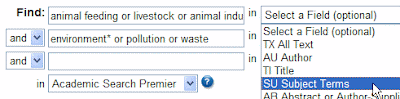
Subject Searching - Another alternative is to take the best subject keywords and phrases and put them together into a subject search. For my first concept the best matches are: Animal feeding, Livestock, Livestock factories, Animal industry. 'Livestock' as a single keyword captures both of those two subject headings, but 'animal' is too broad so I will have to use both of those phrases. My second concept can stay the way it is - all of those keywords have matching subjects. So I am going to return to my search and retype the first line, and adjust the target of both lines from 'Select a field (optional)' which broadly searches the title, author, subjects and abstracts. Here is how that looks:


And here is the search with parentheses and the 'subject' tags: SU ( animal feeding or livestock or animal industry ) and SU ( environment* or pollution or waste ). If you click on the link to run it you will see there are over 350 full text articles.